
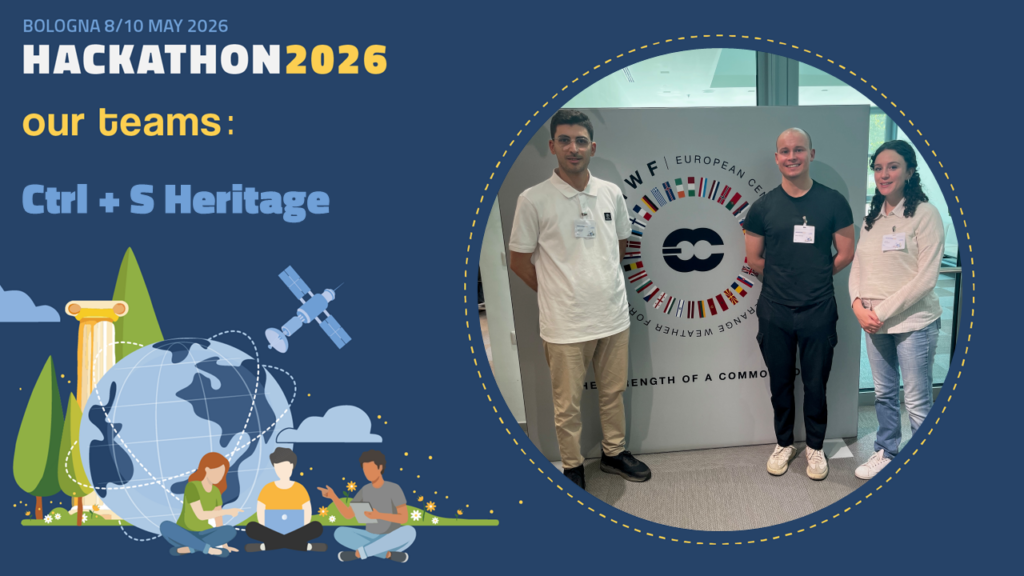
TEAM Ctrl+S Heritage
Team “Ctrl+S Heritage”: Hadi Kheiri Gharajeh, Niklas Becker, Giulia Boccacci Seasonal multi-hazard forecasting framework for Bologna’s built heritage under a changing climate Abstract: Built heritage in urban contexts is increasingly threatened by multiple climate-induced deterioration processes under changing climate conditions.
Data:
14 Luglio 2026

Diapositiva4
Team “Ctrl+S Heritage”: Hadi Kheiri Gharajeh, Niklas Becker, Giulia Boccacci
Seasonal multi-hazard forecasting framework for Bologna’s built heritage under a changing climate
5. Ctrl+S Heritage
Abstract:
Built heritage in urban contexts is increasingly threatened by multiple climate-induced deterioration processes under changing climate conditions. The built heritage of Bologna has been selected as a case study to develop a seasonal multi-hazard forecasting framework for climate-induced deterioration.
The proposed framework is structured into three main steps. The first step focuses on climate-risk assessment through the analysis and interpretation of Copernicus Services datasets for the city of Bologna, including temperature and dew point temperature data from C3S, combined with the application of existing climate-risk indicators for different building materials, with particular attention to the Porticoes of Bologna (UNESCO World Heritage Site). The second step concerns heritage condition monitoring, through future photomonitoring activities and/or the consultation of historical documentation to quantify real in situ material deterioration and material loss over time. The third step addresses future maintenance and restoration needs, including economic cost assessment and management implications to support intervention prioritization and resource allocation across multiple stakeholders. By integrating seasonal climate information with material-specific climate-risk indicators within this three-step framework, the methodology seeks to improve the understanding of how changing environmental conditions may affect built heritage in the near future, supporting more informed and preventive conservation actions.
The proposed approach intentionally remains open to future developments across different spatial scales. On the one hand, it allows “zooming in” through the downscaling of coarse climate data into urban-scale maps to predict the spatial distribution of possible deterioration risks within the city. On the other hand, it supports “zooming out” by transferring the methodological approach to other immovable heritage assets worldwide, promoting the broader applicability and scalability of the framework across different climatic and cultural contexts.
Ultimo aggiornamento
8 Giugno 2026, 18:18