
TEAM ClimaPulse
Team “ClimaPulse”: Maurizio Amadori, Sarah Sildatke, Zaw Thu Htet Turning Climate Signals Into Health Warning Abstract: Climate change and deteriorating air quality are placing increasing pressure on public health systems across Europe.
Data:
11 Agosto 2026

Diapositiva10
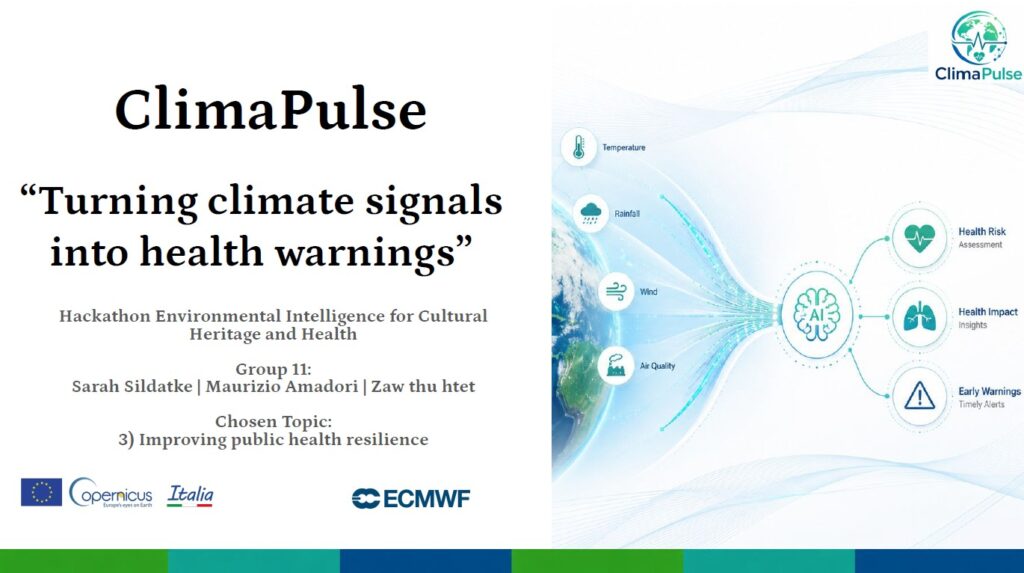
Team “ClimaPulse”: Maurizio Amadori, Sarah Sildatke, Zaw Thu Htet
Turning Climate Signals Into Health Warning
11. ClimaPulse
Abstract:
Climate change and deteriorating air quality are placing increasing pressure on public health systems across Europe. Heatwaves, ozone peaks, particulate matter exposure, and combined atmospheric events are linked to higher numbers of respiratory and cardiovascular emergencies, increasing demand on emergency medical services, hospitals, and public health authorities. Yet, operational healthcare planning often remains reactive and is rarely supported by predictive environmental intelligence.
This project addresses this gap by transforming climate and air-quality information from Copernicus services into actionable health-risk insights for healthcare administrators and emergency response planners. The solution combines emergency call records with climate information from the Copernicus Climate Change Service (C3S) and atmospheric variables from the Copernicus Atmosphere Monitoring Service (CAMS) to identify how environmental stressors are associated with emergency demand.
The platform aims to support short-term health-risk forecasting by anticipating periods when emergency pressure may increase. By integrating environmental forecasts with historical emergency medical service patterns, the system seeks to provide early warnings for climate-and pollution-related surges in healthcare demand. This can help decision-makers allocate staff, ambulances, and healthcare resources more proactively.
A key innovation is the investigation of both linear and nonlinear combinations of atmospheric variables. Instead of treating environmental indicators separately, the project examines compound exposure effects, such as interactions between heat stress and air pollution, to better reflect real-world health impacts.
The workflow begins by filtering emergency call center records to identify incidents potentially related to climate and environmental health risks. In parallel, CAMS European
air-quality forecast data are collected and preprocessed through daily aggregation, cleaning, noise reduction, and harmonization with emergency call data. Statistical analyses are then conducted at the Berlin district level to assess relationships between atmospheric conditions and health-related emergency incidents.
The resulting insights are incorporated into a predictive framework that estimates the likelihood of climate- and air-pollution-related health risks across Berlin districts. Through intuitive visualization and clear risk communication, the platform is designed to support interpretable, operationally relevant decision-making rather than simply displaying environmental data.
By connecting environmental intelligence with healthcare planning, the project contributes to strengthening public health resilience against climate change and increasing atmospheric hazards.
Ultimo aggiornamento
8 Giugno 2026, 19:14