
TEAM Double Doubt
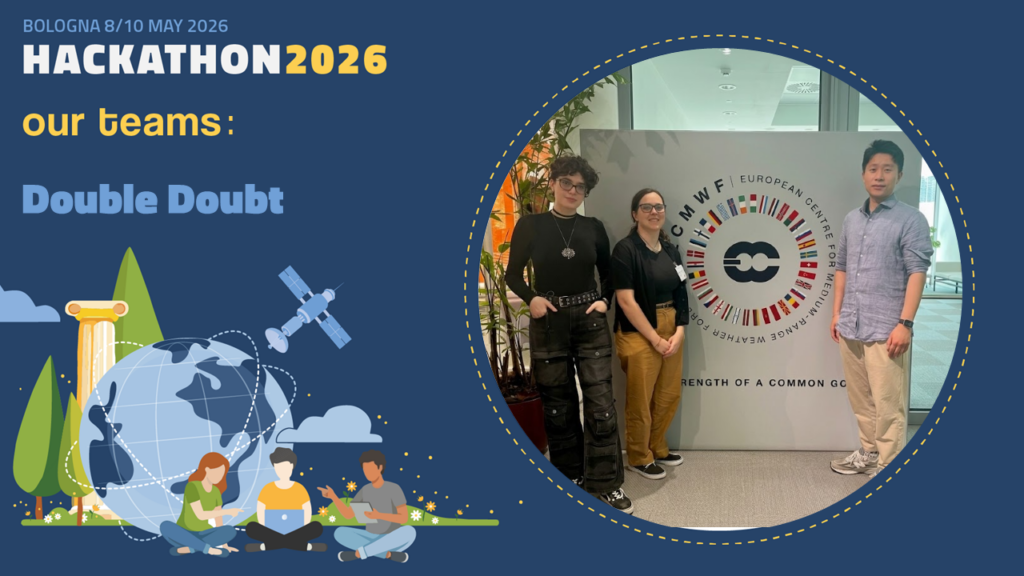
🥉 TERZO CLASSIFICATO TEAM “Double Doubt” Federica Greta Libardo, Shixin Zhao, Chiara Rivi Underwater Risk Classification for Heritage INdex (URCHIN) Abstract: Underwater cultural heritage (UCH) includes shipwrecks, submerged settlements and other archaeological remains preserved in marine environments.
Data:
23 Giugno 2026

🥉 TERZO CLASSIFICATO
Diapositiva8
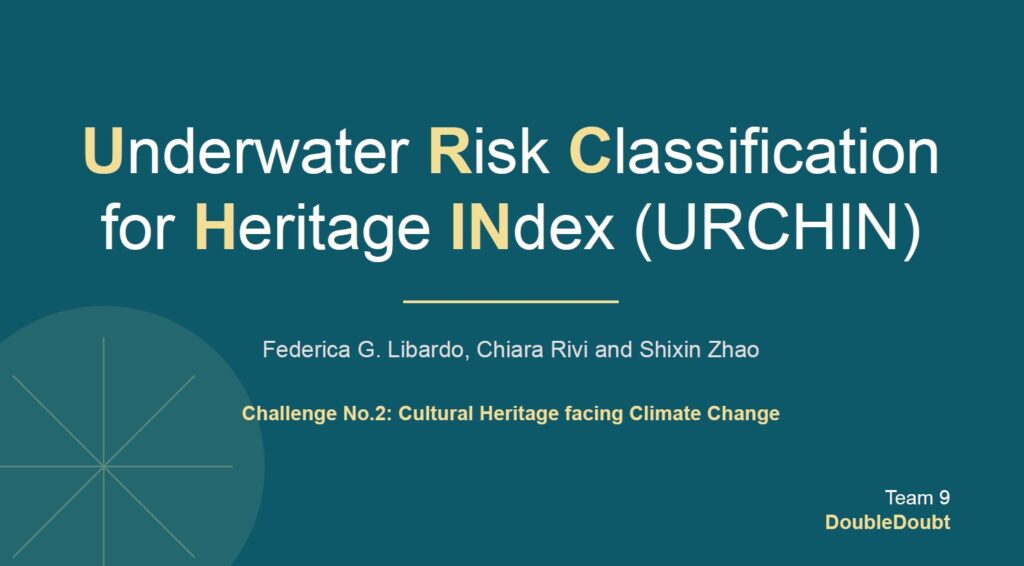
TEAM “Double Doubt” Federica Greta Libardo, Shixin Zhao, Chiara Rivi
Underwater Risk Classification for Heritage INdex (URCHIN)
9. Double Doubt
Abstract:
Underwater cultural heritage (UCH) includes shipwrecks, submerged settlements and other archaeological remains preserved in marine environments. These sites are increasingly exposed to climatic changes in seawater temperature, acidity, oxygen, salinity and hydrodynamic conditions. Such changes can intensify chemical decay including corrosion, erosion, and biological growth. Yet UCH is underrepresented in climate adaptation planning, and many conservation responses remain reactive, local and case-specific.
Current risk assessment tools for UCH rarely combine marine climate projections with heritage site data. This limits the ability of heritage managers and policy-makers to identify which sites may face increasing environmental stress, or to plan monitoring and conservation actions. A simple, climate-informed method is therefore needed to support early screening, resource planning and long-term adaptation.
Here we propose URCHIN, the Underwater Risk Classification for Heritage INdex. URCHIN is a conceptual risk assessment tool for exploring climate-related threats on UCH. It combines marine climate data from the Copernicus Climate Change Service with geospatial datasets of underwater heritage sites. The method focuses on five variables: temperature, dissolved oxygen, water velocity, pH and salinity. These variables were selected because they are linked to key deterioration processes affecting submerged cultural heritage.
Each variable is grouped into low, medium or high anomaly classes and given a weight based on its likely contribution to UCH risks. These weighted values are then combined into a normalized score, which assigns each site to simplified risk levels. URCHIN also separates two planning scenarios: a near-term 5-year future for planning and research, and a longer 30-year scenario for adaptation and mitigation.
As a proof of concept, URCHIN is applied conceptually to the UK shipwreck data alongside marine biogeochemical and physical projections. The outcome is a predictive risk model, with screening tool that shows where environmental stress may increase under future climate conditions. This helps shift UCH conservation from reactive to preactive. Future work can add material-specific deterioration pathways, wider vulnerability factors and local conservation knowledge to support climate resilience for underwater heritage.
Ultimo aggiornamento
8 Giugno 2026, 19:20